How to Make Your USMLE Step 1 Prep More Focused and Manageable
Daryl Fillion
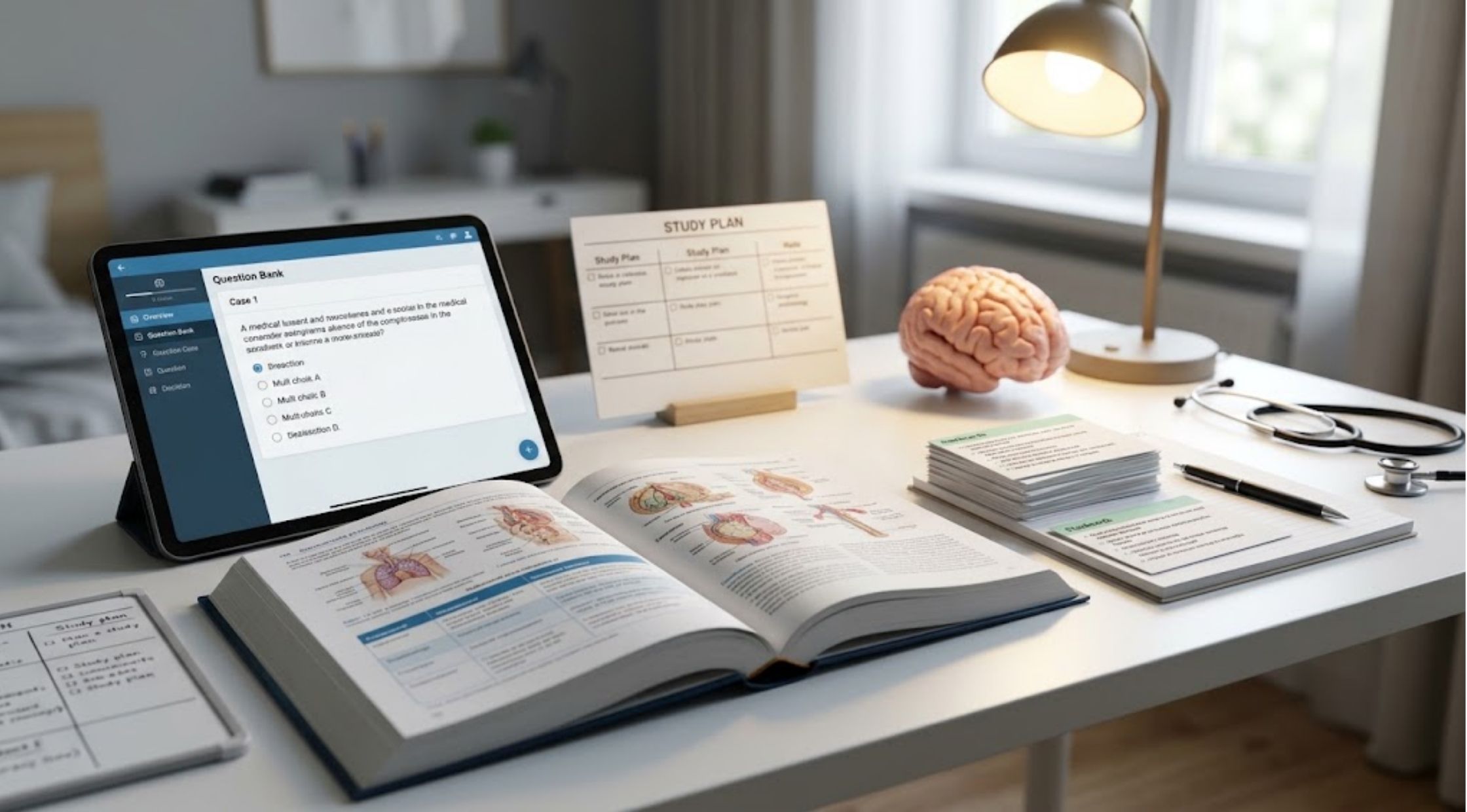
You open your laptop intending to study for an hour.
You open your laptop intending to study for an hour. Three hours later, you've watched two videos, reviewed dozens of flashcards, answered a handful of questions, and somehow feel less confident than when you started.
Sound familiar?
Preparing for Step 1 can become overwhelming quickly. There is a huge amount of basic science to review, countless study resources to choose from, and plenty of advice telling you that you need to use one more book, another QBank, or another flashcard deck.
The problem isn't always a lack of effort. Often, it's a lack of structure.
A more effective approach to USMLE Step 1 Prep starts with understanding what you actually need to learn, how the exam tests it, and which resources genuinely support your study process.
Why Step 1 Preparation Can Feel So Overwhelming
Too Many Resources, Not Enough Direction
One of the biggest challenges is resource overload.
You may have a primary review book, lecture notes, videos, flashcards, question banks, practice exams, and dozens of recommendations from classmates. Each resource may be useful individually, but trying to use everything at once can make studying inefficient.
Instead of asking, "What else should I add?" ask, "What is missing from my current study system?"
That small change can help you reduce unnecessary material and focus on resources that solve specific learning problems.
Medical Subjects Don't Exist in Isolation
Another challenge is that Step 1 requires you to connect concepts.
Pathology, physiology, pharmacology, anatomy, microbiology, and other foundational sciences often overlap within the same clinical scenario. Studying each subject as a completely separate topic can make those connections harder to recognize.
The USMLE itself describes Step 1 as an assessment of basic science knowledge that requires examinees to apply principles and interpret clinical, graphic, and other information.
That's why simply memorizing isolated facts may not be enough. Your preparation should help you understand how concepts relate to one another.
What Makes a USMLE Step 1 Study Guide Useful?
A good USMLE Step 1 Study Guide shouldn't simply give you more information. It should help you organize information.
Look for High-Yield Organization
Your study material should make it relatively easy to identify the concepts you need to understand and review.
Instead of spending hours searching through different resources for information about one disease, look for materials that bring relevant concepts together.
Choose Visual Learning Where It Helps
Some medical concepts are difficult to understand through paragraphs alone.
Diagrams, charts, illustrations, comparison tables, and visual explanations can make relationships easier to recognize and review later.
This can be particularly useful for subjects involving pathways, mechanisms, anatomy, pharmacology, and disease processes.
Make Sure the Material Supports Active Learning
Reading can build your foundation, but questions force you to retrieve and apply information.
The official USMLE materials provide sample questions and an interactive testing experience, which can help examinees become familiar with the format and style of Step 1 questions.
Your preparation should therefore include both content review and active practice.
How to Build a More Effective Study Routine
1. Start With a Baseline
Before creating an elaborate schedule, determine where you currently stand.
Use a diagnostic assessment or practice questions to identify weaker areas. You don't need to know everything before you begin. You need to know where your biggest gaps are.
2. Create a Core Resource System
Rather than switching between five different books every day, choose a primary source for content review and a reliable question bank for practice.
Additional resources can be used when you genuinely need clarification.
This prevents what many students experience as "resource paralysis," spending more time deciding what to study than actually studying.
3. Connect Questions to Content Review
Don't treat your question bank and study guide as two unrelated activities.
If you repeatedly miss questions about renal physiology, for example, return to that topic in your main resource. Review the underlying mechanism, then test yourself again.
This creates a useful cycle:
Question → Identify Gap → Review Concept → Practice Again
4. Review Incorrect Answers Properly
Getting a question wrong isn't automatically a bad thing.
The important part is understanding why you missed it.
Ask yourself:
- Did I lack the underlying knowledge?
- Did I misread the question?
- Did I confuse two similar conditions?
- Did I forget a mechanism?
- Did I choose an answer before considering the full clinical picture?
This turns mistakes into study material.
Don't Confuse More Studying With Better Studying
During USMLE Step 1 Prep, it can be tempting to measure progress by the number of hours spent studying.
But ten unfocused hours aren't necessarily more valuable than several hours of deliberate learning.
Try organizing your day around specific outcomes instead.
For example:
- Morning: Practice questions
- Midday: Review explanations and weak concepts
- Afternoon: Focused content review
- Evening: Flashcards and active recall
Your exact schedule can vary, but the principle is consistent: every study session should have a purpose.
A More Integrated Approach to Step 1 Preparation
For students who are tired of constantly moving between disconnected resources, an integrated USMLE Step 1 Study Guide can simplify the process.
MedSchoolBro's current Complete USMLE Step 1 Guide is designed around integrated learning, bringing anatomy, physiology, pathology, and pharmacology together around disease processes. The guide is available as a 381-page hardcover and interactive eBook, with visual illustrations and an accompanying AI assistant included with the current bundle.
The broader MedSchoolBro Step 1 collection also includes flashcards and a Step 1 question bank, allowing students to combine content review with active practice.
The value of this type of resource isn't simply having another book on your desk. It's having a more organized framework for connecting information.
What Can Improve When Your Resources Work Together?
Less Time Searching
When related concepts are organized together, you spend less time jumping between multiple sources looking for missing information.
Better Concept Connections
Integrated material can make it easier to see how physiology, pathology, pharmacology, and anatomy relate within the same disease process.
More Consistent Review
A clearly structured resource can make it easier to return to weak areas instead of repeatedly starting from the beginning.
More Focused Practice
Combining content review with questions gives you opportunities to learn the concept and then test whether you can apply it.
MedSchoolBro's current Step 1 QBank, for example, includes NBME-style questions, diagnostic assessments, question walkthroughs, active-recall tools, and illness scripts.
Build Your Preparation Around Understanding
The goal of USMLE Step 1 Prep isn't to collect every study resource available.
It's to build a system that helps you understand the material, identify weaknesses, practice applying concepts, and revisit information consistently.
Start with the official exam content outline, establish your baseline, choose a manageable set of core resources, and use practice questions to guide your review.
If you're looking for a more integrated way to organize your preparation, resources such as those offered by MedSchoolBro can provide a combination of structured content, visual learning, flashcards, and question-based practice.
Ultimately, the best study setup is one you can actually follow. A focused plan, consistent practice, and carefully selected resources can make a huge syllabus feel much more manageable and help you spend less time wondering what to study next and more time actually learning.
Comment:
Your email address will not be published. Required fields are marked *
Search
Related Posts

Jun 24, 2026
How to Make Pilates Workouts More Effective and Consistent
Starting a fitness routine often feels easier than maintaining one.
May 22, 2026
How to Choose the Right Fitness Supplements for Better Training Results
Starting a fitness routine may seem simple at first.

Sep 10, 2026
How to Choose the Right Callaway Golf Equipment for Your Game
With the right golf equipment, your time on the golf course will be more enjoyable and you'll have the opportunity to create a golf course setup that suits your game.